The Search for Self & Life motivation

I have been thinking about a simple question: Who am I? We spend a lot of our life creating an identity. We identify with our body, our mind, our work, our relationships, our achievements, our failures, and our desires. Much of our motivation also comes from this identity. We want to become successful, respected, wealthy, loved, or important. But what happens when some of these things disappear? Perhaps the career is no longer exciting. Perhaps the children have grown up and gone to college. Perhaps we have achieved what we wanted and still don’t know what is next. Or perhaps we simply don’t have much desire left. This can feel like a midlife crisis, or even like there is nothing left to live for. But what if the problem is not that we have run out of things to do? What if we have been searching for our identity in the wrong places?

Awareness → Attention → Ego → Desire → Happiness → Surrender → No-Mind

1. What is “I”?

“I” is an illusion. We have a body. We have a mind. We mistakenly think that the body is I or the mind is I. We also create an identity from what we pay attention to. We become what we pay attention to. For example, when I am focusing on my breath, I become the breath. When I am thinking, I become the thinking. But I think none of this is the true I. The body changes, thoughts change, careers change, relationships change, and even our desires change. If all these things can change, then perhaps they cannot be the deepest identity of who we are.

2. Who are we?

Who are we? I think I can simply say that “I am” alive. That aliveness sensation is awareness. Before saying I am a father, I am a professional, I am successful, I am unsuccessful, I am rich, or I am poor, there is simply “I am.” These identities come later. This is important because many of us spend our whole life trying to protect or improve these identities. Then one day a job ends, children leave home, money is no longer exciting, a relationship changes, or the body becomes older, and we wonder, “Who am I now?” Perhaps we are asking this question because we have mistaken our roles for our identity.

3. What is attention?

We become what we pay attention to. That attention is like a torch beam. Wherever we point the torch, that becomes the center of our experience, and slowly we may start identifying with it. If all my attention is on my career, I become my career. If it is on money, I become money. If it is on my problems, I become my problems. If it is on my thoughts, I become my thoughts. But we are not the beam. We are the source of that torch, that attention beam. Attention moves from one object to another, but the awareness behind it remains.

4. Why do we feel lost in midlife?

Perhaps a midlife crisis is sometimes an identity crisis. For many years, life gives us ready-made identities: student, professional, husband or wife, parent, provider, achiever. We keep moving because there is always something to become. Then the children grow up and go to college. The career may become repetitive. We may have enough money. We may have achieved many of the things we once wanted. Suddenly there is no obvious next identity to create. We ask, “What is next?” Perhaps the answer does not have to be another identity. Perhaps this is an opportunity to question the whole search for identity.

5. What if I have no desire?

What if I don’t have another big desire? What if I don’t want another promotion, another house, another relationship, another achievement, or another adventure? I don’t think that automatically means life has no meaning. Maybe it means the mind is tired of constantly becoming something. We have been taught that motivation comes from wanting something. But perhaps there is another way to live. We can continue doing what is necessary without needing a huge desire behind everything. We can take care of the body, spend time with people we love, do our work, help others, learn something, write, walk, sit quietly, or simply experience a day. Life does not have to be justified by a new achievement.

6. Do we have a purpose?

Do we have a purpose? I think the purpose is just to be. We spend much of our life trying to become someone — successful, respected, wealthy, knowledgeable, or important. But if these are identities created by the mind, what happens when we stop trying to become something? Perhaps nothing needs to happen. We can simply be alive. If we want happiness, we should know we are the awareness. Why inquire into awareness? Because without inquiring into it, we’re always seeking happiness in objects and identities. We think the next achievement, relationship, possession, or experience will finally make us complete. But perhaps lasting happiness comes from realizing that we don’t need to become someone else to be whole.

7. Is there personal doership?

Before understanding personal doership, let’s understand what ego is. Ego is a false identity, the false I, the illusion. When we do a task, ego takes the credit that I did it. We then build an identity around what we have done: I am successful, I am intelligent, I am important, or I am a failure. In reality, the task is done by the body-mind-intellect combination. So, there is no personal doership, as a person sitting in the body. Do we have free will? Yes, we have free will from the body-mind-intellect perspective. Intellect changes, so decision-making changes. So, we have free will. But still, that change is also happening automatically, as per our learnings and experiences. Seeing this may reduce the pressure to constantly prove who we are.

8. How should I live my life?

Desires are traps. Basic living needs are required. Anything beyond basic needs can become a desire trap when we start believing that fulfilling the desire will complete our identity. We want to be richer, more successful, more respected, more attractive, or more important because we think these things will improve who we are. But perhaps we don’t need to reject life or stop doing things. We can work, earn money, raise children, maintain our health, write, make friends, and enjoy experiences. The difference is that these things don’t have to answer the question of who I am. Living a simple, natural, unforced life may mean doing what needs to be done without constantly asking life to give us a new identity.

9. What about pleasures and pain?

Pleasures and pain are traps. Pleasures are like searching for happiness outside. Pain is like being sad when a desire is not fulfilled. One pleasure leads to another. One desire leads to another desire, in a constant search for happiness. We create an identity around these desires: I want this, I need this, I must become this. When that identity is challenged, we suffer. For any suffering, desire is the root. So, giving up desires is a way towards happiness. It does not necessarily mean giving up everything we enjoy. It may simply mean giving up the belief that the next pleasure, achievement, or relationship will finally tell us who we are.

10. Why surrender the ego?

I think surrender is going back to the search for happiness. It is also a way of surrendering the false identity of “I am the doer.” Instead of thinking, “I am doing everything and I must control everything,” surrender means letting go of some of that control. Perhaps surrender is not about giving up on life, but about letting go of the identity that says, “I know what should happen.” When we surrender, we may discover that we don’t have to constantly create the next version of ourselves.

11. Why is there an urge to do something?

I think it is needed for survival to do something. I also think it is due to social structure. We are taught to become something. Become successful. Become rich. Become respected. Become somebody. The mind keeps waiting for the next thing, and the identity we have created keeps asking us to improve it. Perhaps this is why someone can reach middle age, have a good job, money, a home, children, and many achievements, and still ask, “What is next?” The mind is waiting for another identity to chase.

12. What happens when there is nothing left to become?

Maybe this is the most important question. Imagine someone whose children have gone to college, whose career has reached a comfortable point, and who no longer feels excited by another promotion or another possession. They may think, “I have done everything. What is left?” Or imagine someone who has not achieved those things and has simply lost the desire to pursue them. In both cases, perhaps the answer is not to manufacture another desire. Perhaps it is to discover that life does not end when becoming ends. We can move from becoming to being. We can still act, work, love, serve, learn, and experience life, but we don’t have to use all of these things to construct an identity.

13. What is no-mind?

Maybe this is where no-mind comes in. Mind means thoughts, waiting, wanting, and becoming. No-mind means there is no need to become something. There is simply being. The body and mind can still function. We can still work, take care of family, write, speak, and do our duties. But underneath all of this, there can be a quiet understanding: I don’t have to become something to be. I already am. Perhaps the joy we are searching for is experienced when the constant movement of the mind becomes quiet and we are simply present.

Awareness → Attention → Ego → Desire → Happiness → Surrender → No-Mind

Maybe the search for identity ends when we realize that the Self is not an identity we have to create. The job may change. The children may leave home. The body may age. The desires may come and go. The roles we play in life may change completely. But the simple sense of “I am” remains. Maybe this is what we can discover in the middle of life: we don’t need to find another reason to become someone. We can learn to simply be someone who is alive. And perhaps the search ends where it begins — with simply “I am.”

14. What do I do when I don’t know what to live for?

Maybe the answer is simple: learn to live. If I don’t have a big desire, I don’t need to immediately create one. I can take care of my body, do my basic duties, spend time with people, earn what I need, help where I can, learn something, walk, sit quietly, pray, meditate, write, or simply enjoy an ordinary day. I can continue living without constantly asking, “What is next?” Perhaps motivation does not always have to come from a big goal. Sometimes life itself can be enough. I can do what needs to be done and allow the rest to unfold naturally.

15. What if I feel there is nothing left?

Maybe there is nothing left to become. And perhaps that is not a problem. We spend our lives becoming someone: a student, a professional, a spouse, a parent, a successful person. Then some of those identities disappear. The children grow up. The career slows down. The excitement of money or achievement fades. We may feel empty because we are looking for another identity to replace the old one. But perhaps this emptiness is an invitation to stop becoming and start being. I don’t need a new identity to continue living. I can simply be alive and see what life brings.

16. So, how do I continue living?

Perhaps I continue living by making life simple. I do my duties. I take care of myself and the people around me. I stay connected. I do things that feel natural rather than forcing myself to chase things I don’t really want. I give myself permission to have small desires without making them my identity. And I spend some time becoming quiet, where I am not waiting for the next thing. Maybe this is what it means to learn to live: not constantly asking life to give me something, but learning to experience the life that is already here.

Maybe the goal is not to find another reason to live. Maybe it is to discover that being alive does not require a reason.

I am. That is where life begins.

Letting Go: The Power of Service Over Title

Becoming That Imaginary Person

It’s as if we carry an image of who we should become one day. Every day, we chase that image. We hope that one day we will be a “big” and “successful” person. We spend a lot of time trying to “be someone.” Someone successful. Someone respected. Someone intelligent, ethical, spiritual, and admired.

We hold a self-image of a person who is ethical, intelligent, worthy of love, happy, and full of great qualities.

We keep hoping that one day we will become that person. One day we will be big, confident, successful, and recognized. One day.

Until that “one day” comes, we keep trying and improving. We carry that image on our shoulders without realizing that it can become a burden. What if we simply let go of that image?


Hope and Becoming

We have a strong hope to become that future version of ourselves. But when will that one day come? Is it guaranteed? Why do we think we must “become” something?

An alternate way of living is to let go of all becoming. Release the wish to be famous, the richest, or the strongest. Stop trying to be the imaginary “good” person.


Who Cares About Your Image?

We try so hard to become someone. But whom are we doing it for? Who really cares if you are successful? Does the world care how powerful nuclear energy is? It only cares if it can use it for its purpose.

So why do you care? Who wants to protect this image? Isn’t it your ego? Some spiritual teachers say there is barely any doer. We simply act according to our past conditioning.

If that is true, then why burden ourselves with an image?


Stop Becoming, Be Neutral

Instead of trying to become that perfected “good person,” what if we live as a neutral human? A human is not stuck as good or bad. A human can act wisely in one moment and foolishly in another.

You are a human mind. Not a fixed identity.


In Control and Out of Control

Some things are in our control. Some things are not.

  • We can put effort into learning a skill. But we can’t control getting a specific job title.
  • We can help our kids learn well. But we can’t control which university they get into.
  • We can act with our best intentions. But we can’t control how others think of us. Their views come from their own conditioning.

Our effort is ours. The result is not. When we forget this, we suffer.


Act Today as Service

Let go of the pressure to become someone big tomorrow. Let go of the image you are trying to protect. Just do what you can, sincerely, today. No image. No label. Only action—service expressed through contribution. Here are some examples:

  • If you want to be a leader, read a little about leadership today. Act a little more like a leader today. If someone criticizes you, learn from it and adjust if needed.
  • If you want to write, write today with the intention to contribute, without hoping to become a famous writer.
  • If you act in a certain way and others criticize you, know that it is their perspective. It is your image they made in their mind. You are not that imaginary person.

Closing

Let go of the image. Let go of the imaginary becoming. Let life flow through you. Pretend as if the universe is acting through you in whatever good or bad way it is. Let your actions speak, quietly, steadily, and with purpose. Action today is enough.

Something to look forward to

Why we need something to look forward to:

Beyond regular duties of life, achieving goals, we need something that we truly enjoy just for the sake of doing it. We have talked about simplifying life to a North Star Goal – a guiding principle that helps us navigate our life challenges and stay focused. We all have many priorities to juggle for in the life. Yet, even with this clarity, life can feel overwhelming. Our minds constantly seek happiness: sometimes through success at work, sometimes through harmony at home. But what happens when neither is going as planned? How do we keep going when life doesn’t cooperate with our expectations? The answer lies in finding something that nourishes us from within — something that keeps us grounded and joyful, no matter the external circumstances.

How to convince your mind to do it: Identifying what we like is an important step. But it is not enough. The harder part is allowing ourselves to spend time on it — without guilt. For example, you know that at work you need more engagement and at home, you have tasks to be done. In such a situation, how do you convince yourself to spend time on your interest? For me, it’s not easy. I may end up doing work first. To convince myself to spend time on an interest or hobby, I try relating it directly to my work productivity. For example, we are convinced that time spent on physical fitness is not a waste of time as it provides us with energy to do what we want to do in a day. Similarly, we need mental “fitness” time that generates happy hormones so that we can stay motivated to continue living the life we imagined.

How to find what we like: I think we need to find our interest where we feel joy of doing it for the sake of doing it. Some examples of such interest could be reading books, writing articles, curiosity about finances, spiritual seeking inclination, or anything that seems effortless. To find out a task you enjoy, I think the simpler way is to ask yourself:

  1. If you have enough money for your retirement and other family needs, what would you like to do in your free time?
  2. What is a task in that you lose the track of time? In other words, what is the task in that you forget that you are the doer?

Or, try other creative ways to find out what you like. Help me learn what you came up with.

When to do to it in the week: Once we are convinced to spend time on our identified activities, we need to find time to do it. It won’t be easy. Mind may tempt us to skip it for the day or the week. To find time, we have to ruthlessly prioritize. For example:

  1. Daily meditation is equally important as daily physical fitness. Allocate time for it everyday as if it’s an essential sleep routine.
  2. Plan for a half day on a weekend in a way that doesn’t impact family or other commitments. It could be Saturday mornings or Sunday evenings.

Once you identify it, stick to it as we stick to an important work meeting.

Summary: We briefly discussed the value of spending time on a hobby, how to find out what we like, and when to do it in the week. Looking forward to the next steps of implementing it.

Simplifying Life to a North Star Goal

Why we need to simplify life: In the current situation, we have chaos everywhere. There is so much information, so many philosophies, so many distractions, and so much uncertainties about all areas of life like relationship, finances, and politics. In such a difficult time, it’s easy to get overwhelmed and get distracted from the mainstream and essence of life. That’s why it’s more important than ever, to simplify life to live meaningfully.

What are common distractors: In my article, how to simplify life, I have written some basic steps to avoid common distractors. The biggest influencer is the worldwide accessible open social media. In addition to it, human ego makes things more complicated.

What is simplest checkpoint to avoid distractions: The simplest thing I an think of is to scan your decisions from the lens of ego-check. For example:

  • Do I want to get that pair of jeans to show off or do I want it because I like the brand, the comfort, and durability of it?
  • Do I want to become a famous writer who has maximum number of instagram followers or do I want to write because I like writing and I want to help people with my thoughts?

How to create a simple structure to follow: Bringing clarity to life is as important as oxygen. We need a vision for our life, to structure the life in a simpler & a purpose driven way. I had other thoughts about simplifying life further and relating it with Maslow’s law and seven spiritual centers of the body. Here is how I related my earlier defined areas to Maslow’s law and seven spiritual centers:

Maslow’s Law of needsSeven centersMy areas of life
Physiological
Safety
Social
Root
Sacral
Heart
Foundation (Fitness, Finance, Family)
EsteemSolar Plexus
Throat
Third Eye
Forward (Skills, Learning, Achievements)
Self ActualizationCrownFreedom (Autonomy, spiritual liberation)

Explanation of life goals:

  • Foundation: I realized that my basic goals of fitness, finance, and family (including friends and society) are related to a basic foundational needs to live life.
  • Forward: Forward is a name given to efforts we do, to build our self esteem. I like the word Forward as it has a push for an action to look forward to. We can also call it taking actions or doing karma for anything in life. For example, look forward to:
    • Learning to continuously build skills to achieve goals and enjoy.
    • Advancements & Achievements by expressing (doing) in areas like leadership, writing, technical, and other as per our profession and interest.
  • Freedom: It is about transcending the journey and becoming free. It can’t be achieved unless we have a strong foundation and strong self-esteem.

What is a north star goal: We need a north star goal in a word so that we’re not lost into multiple goals. I found it very satisfying and simple to come up with one word, to describe my life. For me, that one word is, Freedom. For me, it means freedom from foundational things like: freedom from diseases; freedom by saving for retirement and other life needs; freedom from family needs by transcending to the world as one family; and finally, freedom from my mind or desires.

What’s next: I’d like to explore what stops us from taking actions to live life we imagine. Stay tuned to read more on it.

References:

  1. Wikipedia, https://en.wikipedia.org/
  2. OnePointAhead, https://onepointahead.com/

How to Simplify Your Life: Key Steps

We live in a well-connected world where life changes faster than ever. Every day, life becomes more complex, with increasing expectations at work, in personal life, and in society. Many of us also want more results, happiness, and productivity. We want to achieve more in the limited 24 hours we have each day.

At work, there is a constant need to learn and execute. For example, if you’re a computer programmer, you must continuously improve your development skills. The same applies to any role in technology. As we advance in our careers, we are expected to acquire higher-level skills, such as understanding the company’s overall technical architecture. Technologies evolve rapidly, while businesses continuously innovate to remain competitive.

In personal life, we face expectations from family, friends, and society. For instance, as a parent of a 3-year-old, you may want to spend quality time with your child. If you cannot, you might feel guilty. Similarly, societal expectations—like participating in social causes—can add pressure. Beyond external demands, many of us hold high standards for ourselves. We want to be productive and increase our self-worth.

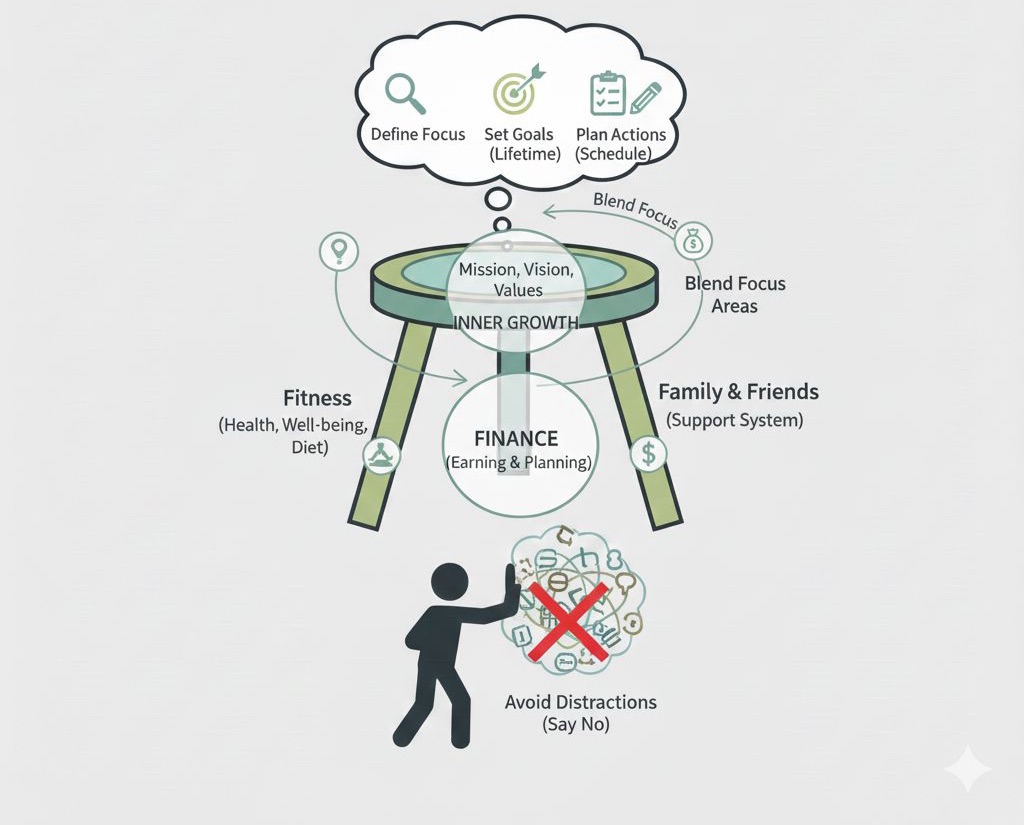
So how can we manage life with so many expectations, needs, and desires? A first step is to define your focus areas, goals, actions, and learn to avoid distractions.


Define Your Focus Areas

Decide what truly matters to live a wholehearted life. Start by listing everything you want to do. Over time, group them into broader focus areas that cover all aspects of life. Clear focus areas help you prioritize and say no to things that don’t align with your core goals.

Examples of focus areas:

  • Inner Growth: This defines who you are, what you want to do in life, and how you will do it. It involves understanding your personal mission, vision, and values. For instance, if your core value is service, your goal is to contribute to others and add value to their lives. Think of Inner Growth as the base of a tripod — the foundation supporting everything else.
  • Fitness: Includes physical health, mental well-being, and a balanced diet. Without fitness, you cannot fully engage in your desired activities. Fitness is the first leg of the tripod.
  • Family & Friends: Support from and to loved ones. Humans are social beings, and having a support system is essential. This forms the second leg of the tripod.
  • Finance: Planning for financial needs is critical. Money is a means to live purposefully, not an end itself. In the tripod analogy, this is the third leg. Financial planning involves leveraging your skills to contribute meaningfully while securing your future.

Blend Focus Areas When Possible

Whenever you can, blend focus areas for a more integrated life. For example, if your Inner Growth emphasizes service, try to serve through work, family, and fitness.

Example: If you have a family business teaching yoga, you can:

  • Spend quality time together as a family (Family)
  • Contribute to society by teaching yoga (Inner Growth / Community)
  • Earn a meaningful living (Finance)
  • Stay fit while practicing yoga (Fitness)

Define Goals

Once focus areas are defined, set goals for each: lifetime, 5-year, 1-year, 1-month, 1-week, and daily goals.

Example for Finance:

  • Lifetime: Estimate total financial needs, including retirement, kids’ education, vacations, and housing.
  • 5-Year: Identify upcoming expenses and plan how to earn and save to meet them. Adjust strategies if necessary.
  • 1-Year: Break the 5-year roadmap into actionable yearly targets.
  • 1-Month / 1-Week / 1-Day: Plan specific actions to achieve short-term and long-term goals.

Plan Actions with a Schedule

Translate goals into actionable steps and schedule them.

Example weekly allocation for focus areas:

  • Inner Growth: 15 minutes of meditation daily, plus reflection throughout the day. On weekends, dedicate more time to Inner Growth activities such as reading, visiting meaningful places, or self-discovery exercises.
  • Fitness: 30 minutes daily, following weekly CDC guidelines — 150 minutes of moderate activity plus 2 days of muscle strengthening.
  • Family & Friends: 2 hours daily with family, weekly calls or visits with extended family and friends.
  • Finance / Work: Focused work time, skill improvement, and relationship-building.

Plan for Unplanned and Ad-Hoc Needs

Life is unpredictable. Reserve a few hours weekly for unplanned tasks. For ad-hoc or exceptional tasks (like a week-long course), accept that you cannot “find” extra time in a regular week. Adjust your schedule, take time off, or delegate other responsibilities to accommodate it.


Avoid Distractions

Desires and external demands can pull you away from focus. Ask yourself:

  • Does this align with my focus areas and goals?
  • Does it help me live according to my mission, vision, and core values?

Examples:

  • Money / Wealth: Focus on earning what you need, not chasing excess for ego.
  • Fame / Recognition: Focus on contribution rather than social media validation.
  • Respect / Influence: Focus on creating an environment of mutual respect rather than personal prestige.

Learn to say no to tasks or demands that do not align with your focus areas. Understanding your mind, body, and ego can help manage distractions, comparisons, and wandering thoughts.


What’s Next

Simplifying life is a skill that takes time and practice. Clarity allows you to plan tasks that are achievable within your limited lifetime. Decide what’s important, act deliberately, reflect on your journey, and seek feedback from others. Inner Growth, combined with planning, reflection, and continuous self-discovery, helps you live a more intentional, productive, and fulfilling life.